
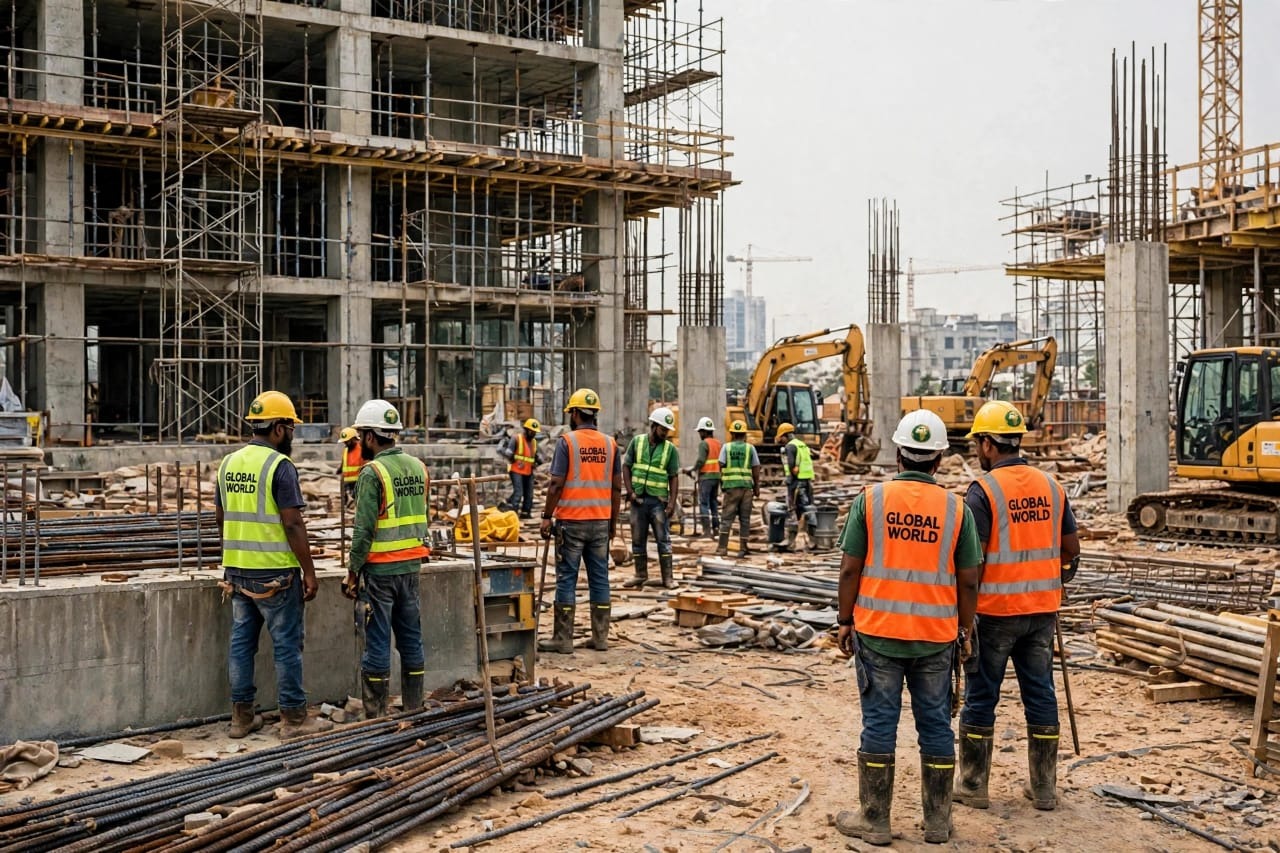
Structural Integrity Begins Before the First Pour
Long-term structural durability in commercial and institutional buildings across Greater Accra depends on disciplined site quality control. Under the Ghana Building Code (GS 1207) and Eurocode 2 (BS EN 1992), achieving specified characteristic strength requires rigorous verification of aggregates, water-cement ratios, reinforcement placement, and curing regimes.
Our Five-Stage Site QA/QC Protocol
- Aggregate Grading & Silt Content Verification: Fine and coarse quarry aggregates are washed and sieve-tested to eliminate deleterious clay fines and organic impurities that weaken cement paste bonding.
- Reinforcement Steel Verification: Every consignment of deformed high-yield rebar is checked for mill certificates, rib geometry, and independent tensile yield strength prior to cutting and bending.
- Cover Block & Formwork Dimensional Checks: Pre-pour inspections verify spacer block density, plumbness of column shutters, and structural rebar lap lengths before any batch truck is discharged.
- Slump & Compressive Cube Sampling: Six 150mm test cubes are cast per pour batch for 7-day, 14-day, and 28-day crushing tests at an accredited materials laboratory.
- Wet Curing & Controlled Striking: Columns and suspended slabs undergo continuous wet hessian and membrane curing to prevent plastic shrinkage cracking in tropical ambient temperatures.
#Building Construction
#Structural QA/QC
#GS 1207
#Accra
Consult Our Engineering Team →